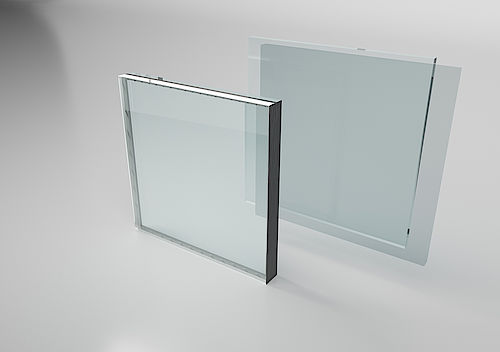
The hazards facing machine tool operators are immense: chips reach high speeds, and clamped workpieces can come loose or break, flying through the work area with great force. Machine safety windows provide a clear, protected view of the ongoing production process—for instance, during machine setup or visual inspections. This is made possible by a composite material of the type manufactured by HEMA.
High level of security through a combination of safety glass and polycarbonate.
Safety windows in this application area are susceptible to damage. Standard polycarbonate windows quickly become brittle due to continuous contact with cooling lubricants. HEMA constructs its machine safety windows as a composite of polycarbonate and safety glass, optimally combining their protective properties.
The safety glass is resistant to cooling lubricants and chips, keeping them away from the polycarbonate layer. The polycarbonate, in turn, is positioned on the operator side. Thanks to its material structure, it offers high retention capability. Consequently, should the window sustain damage, the risk of injury is significantly lower than with standard safety windows. Tests have shown this composite construction to be highly robust.
Machine safety windows are designed according to protection classes.
HEMA individually configures, manufactures, and fully seals safety windows for any machine tool, tailoring dimensions to the specific application and ensuring compliance with the applicable Machinery Directive. Depending on customer requirements, these machine safety windows can be produced with frames of various contours or as curved units with a specific radius. Pre-integration of a SPINVISTA rotating window is also an option.
HEMA determines the design and material thickness combinations—utilizing safety glass and polycarbonate—based on the required protection class. This ensures the level of protection is appropriate for the potential hazards associated with CNC machines or turning and milling centers, such as those arising from high production speeds or the size of the workpieces being processed.